Category: Social

  • Science Corrects Itself: The Embodied Cognition Story 

    Science Corrects Itself: The Embodied Cognition Story 

    Try giving someone directions while sitting on your hands. It is harder than it should be. Your hands start drawing the map, pointing at the turns, shaping the roundabout — even on the phone, where nobody can see a thing. The body gets involved in work that supposedly belongs to the brain, and for the past twenty-five years psychology has had a name for the idea that this is no accident: embodied cognition. On the podcast this week I walk through the whole arc of this idea — the exciting findings, the collapse of many of them, and the genuinely hopeful way the field responded. This post covers the highlights, with sources at the bottom for students and instructors.

    What Embodied Cognition Claims

    The picture of the mind most of us inherited treats the brain as a computer: input, processing, output, with the body serving as the peripherals. Embodied cognition pushes back. It says thinking is built out of the body’s experiences — that concepts are grounded in sensing and moving. The linguist George Lakoff and the philosopher Mark Johnson laid the intellectual groundwork in their 1980 book Metaphors We Live By, pointing out how much abstract thought leans on physical metaphor. A warm person. A dirty trick. You grasp an idea, weigh your options, carry a heavy secret. Their claim was that these are not decorations on top of thought. They are the structure of thought, learned through the body.

    The Findings That Made Everyone Believers

    The strongest evidence came from neuroscience. In 2004, Olaf Hauk, Ingrid Johnsrude, and Friedemann Pulvermüller put people in an fMRI scanner and had them passively read action words — lick, pick, kick. Your motor cortex is organized like a map of the body, and reading each word activated motor areas overlapping or adjacent to the regions that control the tongue, the fingers, and the feet. Nobody moved. The meaning of the word reached the body’s control panel anyway. This finding, published in Neuron, has been repeated and extended many times, and it still stands.

    Behavioral evidence followed. Arthur Glenberg and Michael Kaschak (2002) reported the action-sentence compatibility effect: people judging sentences like “Art handed you the pen” responded faster when their hand movement matched the direction of the action in the sentence, suggesting that understanding language involves quietly simulating it with the motor system.

    Then the idea got glamorous. John Bargh, Mark Chen, and Lara Burrows (1996) reported that students who unscrambled sentences containing elderly-stereotype words — Florida, bingo, gray — walked more slowly down the hallway afterward, timed by an experimenter with a stopwatch. (Strictly speaking this is social priming, with the arrow running from concept to body rather than body to concept, but the two literatures grew up together and, as you will see, fell together.) Williams and Bargh (2008) found that briefly holding a hot coffee led people to rate a stranger’s personality as warmer. Zhong and Liljenquist (2006) reported the “Macbeth effect”: copying a story about an unethical act made cleansing products seem more desirable. Strack, Martin, and Stepper (1988) found that holding a pen in the teeth — which forces a smile — made cartoons seem funnier. And Carney, Cuddy, and Yap (2010) reported that two minutes of expansive “power posing” raised testosterone, lowered cortisol, and increased risk taking in a sample of 42 people. Amy Cuddy’s 2012 TED talk on that finding became one of the most watched ever.

    I Believed It Too

    Full disclosure: in my book Psych Experiments, I suggested that readers could try the hot coffee study for themselves. It was published in Science. Textbooks taught it. I taught it. This next section is therefore a little personal.

    Then the Replications Came

    Stéphane Doyen and colleagues (2012) redid the elderly walking study with infrared sensors instead of a stopwatch and a larger sample: no effect. Their second experiment is the one every student should know. They manipulated what the experimenters expected — and a walking effect appeared only when the experimenters believed participants would walk slowly. The effect appeared to live in the experimenters, a modern Clever Hans story and a clear demonstration of why double-blind procedures exist.

    Dermot Lynott and colleagues (2014) ran three high-powered direct replications of the warm-pack version of the coffee study — 861 participants in total. No effect in any lab. Brian Earp and colleagues (2014) obtained the original Macbeth effect materials, ran samples about five times larger than the original across multiple countries, and found nothing. A seventeen-lab registered replication led by E.-J. Wagenmakers (2016) tested the pen-in-the-teeth study: the original difference of 0.82 points shrank to 0.03 — a flat line. Eva Ranehill and colleagues (2015) replicated power posing with roughly five times the participants: people felt more powerful, but the hormone and behavior effects vanished, and a p-curve analysis by Simmons and Simonsohn (2017) suggested the supporting literature looked like noise. In 2016, Dana Carney — first author of the original power posing paper — publicly stated that she no longer believed the effect was real.

    And in 2022 came the one that stings: an eighteen-lab, pre-registered replication of the action-sentence compatibility effect, the flagship behavioral finding of the whole field. Not one lab found it, and the pooled estimate of the effect was essentially zero. Look at the author list of that paper: Kaschak and Glenberg — the original discoverers — helped run it and signed it.

    Why Did the Original Studies Find Effects?

    Not fraud, for the most part. Something more ordinary and more instructive. Tiny samples (30 to 42 people) produce results that swing widely from sample to sample, and some of those swings are large by pure sampling luck. Publication bias means journals printed the lucky swings while null results went in the file drawer. Researcher degrees of freedom — which measure to report, which participants to exclude, when to stop collecting data — offered many innocent-looking forks in the road, and enough forks will usually lead to a publishable result. And experimenter expectancy effects, as Doyen demonstrated directly, can manufacture a finding when the people running the study know the hypothesis and interact with participants.

    The Rebuild: Adversarial Collaboration

    Failed replications sparked arguments, and some objections from original authors were reasonable — Strack noted, for example, that the replication labs used visible video cameras, which may make participants self-conscious. The field’s answer to this stalemate is the best part of the story. In 2022, the Many Smiles Collaboration published, in Nature Human Behaviour, a pre-registered test of the facial feedback hypothesis designed jointly by proponents and critics — Strack himself was on the team — with 3,878 participants in 19 countries. The verdict landed in the middle: deliberately posing or mimicking a smile does nudge felt happiness, a real but modest effect, while the pen-in-the-mouth method came back inconclusive. That matches a 2019 meta-analysis by Coles and colleagues: facial feedback is real, and it is small.

    What’s Left Standing

    Here is where things honestly stand: the neuroscience core of embodied cognition is in decent shape — sensory and motor systems really do participate when we process meaning. The flashy social-priming findings have collapsed: coffee cups, cleansing products, and hormone-shifting poses did not survive rigorous testing, and the flagship behavioral effect could not be found by the very people who discovered it. The open question is whether the body’s involvement is necessary for understanding or is more of an echo. Meanwhile the field rebuilt its methods — pre-registration, multi-lab studies, samples in the thousands — and the original researchers helped run the studies that overturned their own findings. People call this the replication crisis. I’d call it science doing exactly what it is supposed to do. And the next edition of Psych Experiments will treat the hot coffee study accordingly: run it, and expect to find nothing — because finding nothing, when the original claim was world famous, is a real result.

    Psychology Terms in This Article

    Embodied cognition — The theory that thinking is grounded in the body’s sensory and motor systems rather than consisting only of abstract symbol processing. In this episode, it is the framework behind everything from the kick-lick-pick fMRI study to power posing.

    Replication — Repeating a study to see whether its results hold up; a direct replication reproduces the original methods as closely as possible. The seventeen-lab test of the pen-in-the-teeth study and the eighteen-lab test of the action-sentence compatibility effect are direct replications.

    Statistical power — A study’s ability to detect an effect if the effect is real, which depends heavily on sample size. The original power posing study had 42 participants; its replication had roughly five times as many, which is why its null result carries weight.

    Publication bias — The tendency for studies that find effects to get published while null results stay in the file drawer, so the published record shows only the successes. This is one reason so many small early studies pointed the same direction.

    Demand characteristics — Cues in a study that hint to participants what the researcher expects, nudging their behavior. Visible video cameras in the smile replications were debated as a possible source.

    Experimenter expectancy effect — The experimenter’s own beliefs leaking into how a study is run and measured, as when a walking-speed effect appeared only for experimenters who expected it. Clever Hans, the “counting” horse, is the classic historical example.

    Pre-registration — Publicly recording a study’s hypotheses, methods, and analysis plan before collecting data, which closes off after-the-fact flexibility. Every major replication discussed in this episode was pre-registered.

    Adversarial collaboration — A study designed and run jointly by researchers who disagree, with the rules agreed in advance. The Many Smiles Collaboration, which included the original smile-study author alongside his critics, is the model case.

    References

    Bargh, J. A., Chen, M., & Burrows, L. (1996). Automaticity of social behavior: Direct effects of trait construct and stereotype activation on action. Journal of Personality and Social Psychology, 71(2), 230–244. https://doi.org/10.1037/0022-3514.71.2.230

    Carney, D. R., Cuddy, A. J. C., & Yap, A. J. (2010). Power posing: Brief nonverbal displays affect neuroendocrine levels and risk tolerance. Psychological Science, 21(10), 1363–1368. https://doi.org/10.1177/0956797610383437

    Coles, N. A., Larsen, J. T., & Lench, H. C. (2019). A meta-analysis of the facial feedback literature: Effects of facial feedback on emotional experience are small and variable. Psychological Bulletin, 145(6), 610–651. https://doi.org/10.1037/bul0000194

    Coles, N. A., March, D. S., Marmolejo-Ramos, F., et al. (2022). A multi-lab test of the facial feedback hypothesis by the Many Smiles Collaboration. Nature Human Behaviour, 6(12), 1731–1742. https://doi.org/10.1038/s41562-022-01458-9

    Doyen, S., Klein, O., Pichon, C.-L., & Cleeremans, A. (2012). Behavioral priming: It’s all in the mind, but whose mind? PLoS ONE, 7(1), e29081. https://doi.org/10.1371/journal.pone.0029081

    Earp, B. D., Everett, J. A. C., Madva, E. N., & Hamlin, J. K. (2014). Out, damned spot: Can the “Macbeth Effect” be replicated? Basic and Applied Social Psychology, 36(1), 91–98. https://doi.org/10.1080/01973533.2013.856792

    Glenberg, A. M., & Kaschak, M. P. (2002). Grounding language in action. Psychonomic Bulletin & Review, 9(3), 558–565. https://doi.org/10.3758/BF03196313

    Hauk, O., Johnsrude, I., & Pulvermüller, F. (2004). Somatotopic representation of action words in human motor and premotor cortex. Neuron, 41(2), 301–307. https://doi.org/10.1016/S0896-6273(03)00838-9

    Lakoff, G., & Johnson, M. (1980). Metaphors We Live By. University of Chicago Press.

    Lynott, D., Corker, K. S., Wortman, J., Connell, L., Donnellan, M. B., Lucas, R. E., & O’Brien, K. (2014). Replication of “Experiencing physical warmth promotes interpersonal warmth” by Williams and Bargh (2008). Social Psychology, 45(3), 216–222. https://doi.org/10.1027/1864-9335/a000187

    Morey, R. D., Kaschak, M. P., Díez-Álamo, A. M., Glenberg, A. M., Zwaan, R. A., Lakens, D., et al. (2022). A pre-registered, multi-lab non-replication of the action-sentence compatibility effect (ACE). Psychonomic Bulletin & Review, 29, 613–626. https://doi.org/10.3758/s13423-021-01927-8

    Ranehill, E., Dreber, A., Johannesson, M., Leiberg, S., Sul, S., & Weber, R. A. (2015). Assessing the robustness of power posing: No effect on hormones and risk tolerance in a large sample of men and women. Psychological Science, 26(5), 653–656. https://doi.org/10.1177/0956797614553946

    Simmons, J. P., & Simonsohn, U. (2017). Power posing: P-curving the evidence. Psychological Science, 28(5), 687–693. https://doi.org/10.1177/0956797616658563

    Strack, F., Martin, L. L., & Stepper, S. (1988). Inhibiting and facilitating conditions of the human smile: A nonobtrusive test of the facial feedback hypothesis. Journal of Personality and Social Psychology, 54(5), 768–777. https://doi.org/10.1037/0022-3514.54.5.768

    Wagenmakers, E.-J., Beek, T., Dijkhoff, L., Gronau, Q. F., et al. (2016). Registered Replication Report: Strack, Martin, & Stepper (1988). Perspectives on Psychological Science, 11(6), 917–928. https://doi.org/10.1177/1745691616674458

    Williams, L. E., & Bargh, J. A. (2008). Experiencing physical warmth promotes interpersonal warmth. Science, 322(5901), 606–607. https://doi.org/10.1126/science.1162548

    Zhong, C.-B., & Liljenquist, K. (2006). Washing away your sins: Threatened morality and physical cleansing. Science, 313(5792), 1451–1452. https://doi.org/10.1126/science.1130726
  • Why the Whites of Your Eyes Shape a Stranger’s First Impression

    Why the Whites of Your Eyes Shape a Stranger’s First Impression

    You meet someone for the first time, and within a second or two you’ve already decided something about them — whether you’d trust them, whether you’d want to keep talking. You didn’t run through a checklist. It just happened. And it turns out one of the things your brain quietly picks up on is something you’ve probably never once thought about on purpose: how much of the white of a person’s eyes you can see.

    A study published in PLOS One by Mathias Boyer-Brosseau, Simon Rigoulot, and Sébastien Hétu looked at exactly that — the sclera, the white outer layer of the eyeball — and how the amount of it we can see shapes our first impressions. I came across this one on PsyPost, in a write-up by Eric W. Dolan, and it’s a great example of how a feature you’d never mention out loud can be doing real work behind the scenes.

    Here’s what they did. They took photos of faces with neutral expressions from a well-known set called the Karolinska Directed Emotional Faces database. Then they digitally created two versions of each face — one showing a smaller amount of visible white (about 31.5% of the visible eye) and one showing more (about 43.8%) — while keeping everything else about the face identical. Then 162 adults rated the faces on four things: how much they’d trust the person, whether they’d interact with them, how attractive they found them, and where they’d place them in the social pecking order.

    The result was remarkably consistent. Faces showing more of the white of the eye were rated as more trustworthy, more attractive, more sociable, and higher in social rank. And this wasn’t a quirk of one group — it held for male and female faces, and for male and female raters alike. A cue you never consciously register nudged four separate judgments in the same direction.

    So why would the amount of white matter at all? Part of the answer is that these judgments are fast and effortless — a textbook case of automatic processing, the mental work that happens without conscious awareness or intent. You’re not deciding to evaluate someone’s sclera; your brain does it for you and hands you a feeling. The researchers offer two evolutionary psychology explanations — the idea that some mental traits stuck around because they helped our ancestors solve social problems. Humans are unusual in having such visible whites, which makes it easy to follow exactly where someone is looking, and reading gaze is a huge part of getting along with other people. On top of that, scleral exposure tends to peak in our early twenties and shrink as we age, so more white may quietly read as youth, health, and vitality.

    There’s another layer here worth naming. A surface feature swaying a bunch of deeper judgments is basically peripheral route persuasion — attitude change that runs on superficial cues like attractiveness rather than on any real evidence about the person. And the ratings all moved together: faces judged attractive were also judged trustworthy, the classic attractiveness halo effect, where one good impression bleeds into all the others.

    I have to admit, as a former college professor this one landed a little uncomfortably. I formed quick reads on students and colleagues all the time, and I’m sure I told myself those reads were based on something substantial. Studies like this are a good reminder that a chunk of my “gut” was probably running on cues about this superficial.

    One honest caveat, and it’s a good one for anyone studying research methods: to add more visible white, the team had to make the eye itself a little bigger, so they couldn’t fully separate “more white” from “bigger eyes.” That’s a confounding variable — a second factor riding along with the one you care about, muddying the cause. The faces and raters were also mostly White, so we don’t yet know how far this travels across cultures.

    What do you actually do with this? You can’t change your sclera, and please don’t try. The useful move runs the other direction: knowing your snap judgments can hinge on something this trivial should make you hold them more loosely. Next time you get an instant read on a stranger, treat it as a first guess, not a verdict — and give the person a second data point before you trust it.

    If you’re taking a psychology course, scroll down — I’ve pulled out the key concepts this research illustrates, so you can see how a real study maps onto the terms you’re studying.

    Psychology Terms in This Article

    Automatic processing — Cognitive processing that happens without conscious awareness, intention, or effort, like recognizing a familiar face. In this study, participants weren’t deliberately measuring anyone’s sclera; the judgments of trust, attractiveness, sociability, and rank formed instantly and effortlessly, which is exactly why a cue this subtle could move them.

    Evolutionary psychology — An approach that treats psychological traits as adaptations that evolved to solve recurring problems for our ancestors. The researchers use it to explain why we’d care about the white of the eye at all: highly visible sclera makes gaze-following easier (crucial for cooperation), and more white may signal youth and health — both things it would have paid off to notice.

    Peripheral route persuasion — Attitude change driven by superficial cues, such as attractiveness or surface features, rather than by the quality of any real information. The whole effect here is peripheral-route in miniature: a small change to one facial feature shifted people’s overall impression of a stranger without adding a single fact about who that person actually is.

    Confounding variable — An extra factor that varies along with the variable you’re studying, offering an alternative explanation for the result. Because increasing the visible white also slightly enlarged the eye, eye size is a confound here — the researchers can’t be fully certain whether it was the extra white or the bigger eye driving the friendlier ratings.

    References

    Boyer-Brosseau, M., Rigoulot, S., & Hétu, S. (2026). Scleral exposure influences social judgments of trustworthiness, attractiveness, sociability, and social rank in White faces. PLOS One. https://doi.org/10.1371/journal.pone.0348193

    Dolan, E. W. (2026, July 28). People judge faces with more visible eye whites as more trustworthy and attractive. PsyPost.

  • Why Nobody Pushed the Button: The Psychology Behind a Subway Tragedy 

    Why Nobody Pushed the Button: The Psychology Behind a Subway Tragedy 

    When someone collapses in a public place, will anyone actually help? It’s one of the oldest questions in social psychology, and the newest research gives a surprisingly hopeful answer. But a recent death in a Boston subway station complicates that answer in a way worth understanding — not because it proves people are heartless, but because it shows exactly where helping breaks down. A quick note before going further: this post describes a real death, and some of it is hard to read.

    Steven McCluskey was forty. He was a carpenter who ran his own home improvement business, a father of two boys, and by his family’s account someone who did his best every day to show up for the people he loved. His family also shared that in recent years he had been struggling with addiction — a detail that matters here, though not in the way it might first seem. A little before five in the morning, at the Davis Square T station in Somerville, Massachusetts, Steven stepped onto a downward escalator, lost his balance at the bottom, and fell. His clothing was pulled into the machinery at the base. The escalator kept running, and he couldn’t free himself.

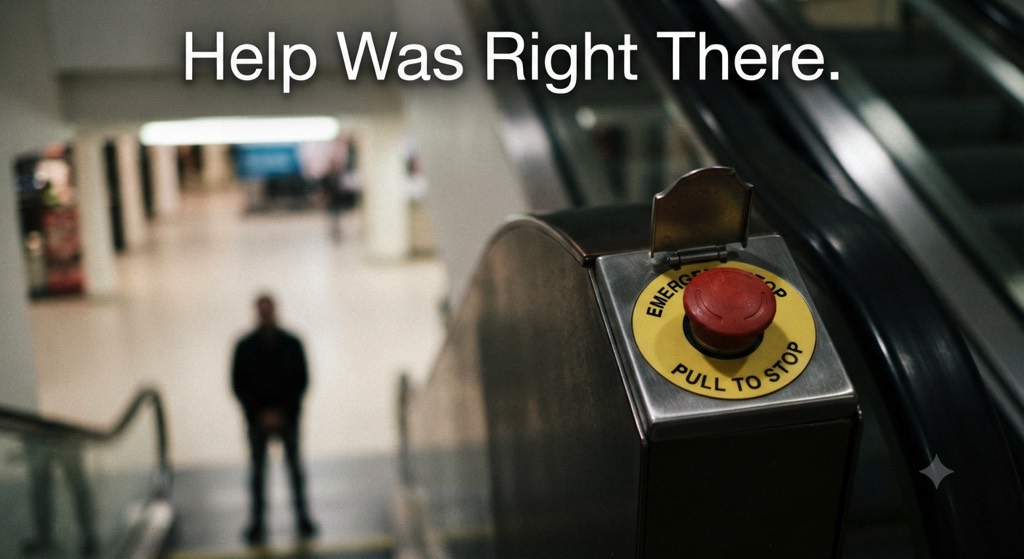
    The station had surveillance cameras, and NBC Boston’s investigative team obtained the footage. Less than a minute after Steven fell, someone came down, appeared to briefly try to help, then continued through the fare gates. Over the next several minutes, more than a dozen people passed by. Some stopped and stared. One man pulled on Steven’s legs for a few seconds and gave up. About eighteen minutes passed before anyone called 911, and more than twenty-two minutes before an MBTA employee pressed the emergency stop button — the red button at the top and bottom of every escalator that anyone standing there can push. Steven was taken to the hospital and died ten days later. His mother, shown the video by the news team after the family had been denied it during the investigation, said they treated him like he didn’t exist, and that if someone had taken one minute, he’d still be here.

    Here is the tension. The most recent and most convincing research on bystander behavior says the opposite of what that footage seems to show. Richard Philpot and his colleagues, publishing in American Psychologist, coded real surveillance footage of public conflicts on real streets across three countries — the Netherlands, the United Kingdom, and South Africa. In roughly nine out of ten of those conflicts, at least one bystander stepped in to help, and usually several did. The old story that nobody helps, that we all freeze, that a crowd guarantees inaction, turns out to be far too pessimistic. So how can that be true and this also be true?

    The honest answer isn’t that the research is wrong or that people are worse than the studies claim. It’s that the study and the case describe two different kinds of situations, and the difference between them is the whole lesson. Philpot’s footage captured public conflicts — fights, arguments, assaults. That kind of event is loud and obvious. There’s a clear aggressor, a clear victim, yelling, shoving. A bystander doesn’t have to work to figure out that something bad is happening. The situation announces itself, and much of the reason the intervention rate ran so high is that the ambiguity had been stripped out. Everyone could see exactly what was going on.

    Now picture Steven at the bottom of that escalator at five in the morning: a man lying still, not moving much. From thirty feet away, to someone half-awake on the way to a train, what does that look like? This is where his family’s mention of addiction becomes relevant, and it deserves care, because it’s precisely the psychology at work. A person lying motionless in a subway station early in the morning is, sadly, a sight many commuters have learned to walk past. Their brain files it under he’s sleeping, he’s intoxicated, this isn’t an emergency. Not because they’re cruel, but because the brain does what brains do with an unclear situation: it reaches for the most familiar explanation. And the most familiar explanation, the one that lets you keep walking, was the wrong one.

    This is the oldest finding in the bystander literature, and it survives all the new research intact. It goes back to John Darley and Bibb Latané in the years after the Kitty Genovese case. They mapped the steps that have to happen before a person helps, and the first real hurdle, once you’ve noticed something at all, is interpreting it as an emergency. Study after study showed that helping quietly dies right there — not because people are heartless, but because an unclear situation gives everyone permission to assume it’s nothing. Darley and Latané gave part of this a name: pluralistic ignorance. You look around to gauge whether a situation is serious, but everyone else is doing the same thing, keeping a calm face while they check — so the whole crowd reads each other’s calm as proof there’s nothing wrong. Fifteen people pass a man on an escalator, and each one sees fourteen others who didn’t stop, and each concludes it must be fine.

    Layered on top of that is diffusion of responsibility: the more people around, the less any one person feels it’s their job to act. Surely someone already called. Surely one of them knows something I don’t. And here’s the cruel irony that ties this back to Philpot’s study. In a loud, obvious street fight, more bystanders means a better chance someone helps, because the situation is clear and all those extra people form a larger pool of potential helpers. But in an ambiguous situation, more bystanders can cut the other way — each additional person who walks past without reacting becomes one more piece of evidence, for the next person, that this is normal. Same crowd size, opposite result. The variable that flips it is whether the situation is clear or ambiguous.

    So when Steven’s mother says they treated him like he didn’t exist, it’s easy to see why it looks that way, and no one should argue with a grieving mother about what she saw. But the psychology suggests the footage doesn’t show fifteen heartless people. It shows fifteen people whose brains each made the same ordinary, understandable, catastrophically wrong call. Any one of them, alone, at five in the morning, might well have stopped. It was the combination — ambiguity, the crowd, the early hour, and the assumptions we’ve all absorbed about a still figure in a transit station — that produced twenty-two minutes of nobody pressing a button that was right there.

    It’s worth staying skeptical of any tidy explanation, including this one. This reading comes from a news report and edited surveillance video; no one knows what was in the mind of each person who walked past. Maybe someone did call. Maybe someone assumed the man tugging on Steven’s legs had it handled. Reconstructing a psychological story from the outside is exactly the kind of thing to be careful about, because we love neat explanations for other people’s behavior. And this isn’t only a psychology story — there are real questions about the escalator’s safety design and how quickly the MBTA responded, questions the family is right to ask and ones psychology doesn’t answer. The claim here is narrow: it explains the part about the people on the stairs.

    The reason the psychology is worth understanding at all comes down to this. If you decide the people who walked past were simply bad people, there’s no lesson in it for you — because you’re not a bad person, so it could never be you. That’s the trap. Fifty years of bystander research keeps landing on the same point: it isn’t about bad people. It’s about ordinary people in a situation structured to produce inaction. Which means it could be any of us. And that’s the hopeful part, because if the cause is the situation and not the character, you can prepare for the situation and inoculate yourself against it in advance.

    A few things make a real difference, and they come straight out of the research. Knowing about the bystander effect changes behavior; people who’ve learned about it are more likely to act, because a small alarm goes off — everyone’s walking past, and that’s exactly when I might talk myself out of helping. Resolve the ambiguity out loud: if you see something and you’re unsure, say so, ask are you okay, because the moment someone answers or doesn’t, the situation stops being ambiguous — not just for you, but for everyone else standing there who was privately uncertain. And if you ever need help, or you’re helping and need others to join, get specific. Don’t call out for somebody to phone 911. Point at one person: you, in the gray coat, call 911 right now. The research is consistent here — the instant help is assigned to a specific person, it can’t be diffused to anyone else.

    That red button stays with me. It sits at the top and bottom of every one of those escalators, and anyone can push it. It’s the whole thing in miniature: help was physically within reach the entire time. What was missing wasn’t the ability to help but the interpretation — the click in someone’s mind that says this is an emergency and it’s mine to handle. That click is what fifty years of research is really about, and it’s something a person can practice making. Steven McCluskey died in the gap between seeing something and understanding it as an emergency. The most useful thing any of us can do with a story this painful is to let it close that gap a little — to be the one who asks are you okay, who says it out loud, who pushes the button. Not out of heroism, but because we thought about it in advance, on an ordinary day, before ever finding ourselves half-awake at the bottom of a staircase looking at someone who needs us.

    Bystander intervention: The act of a witness stepping in to help someone in an emergency. Research increasingly focuses not on whether a lone individual helps, but on the aggregate likelihood that at least one person in a group does.

    Bystander effect: The finding, first demonstrated by John Darley and Bibb Latané, that an individual is less likely, or slower, to help when other people are present than when alone.

    Interpreting the emergency: The step in Darley and Latané’s model where a person decides whether an ambiguous event actually is an emergency. This is where helping most often fails — an unclear situation invites the assumption that nothing is wrong.

    Pluralistic ignorance: A situation in which each person privately feels unsure but reads everyone else’s outward calm as evidence that there’s no emergency — so the group collectively concludes there’s nothing to worry about, even when there is.

    Diffusion of responsibility: The tendency for personal responsibility to feel divided among everyone present, so the more bystanders there are, the less any single person feels that helping is their job.

    Individual versus aggregate likelihood: A distinction the bystander literature often blurs. The individual likelihood that any one person helps can drop as a crowd grows, even while the aggregate likelihood that at least someone helps rises — because a larger crowd is a larger pool of potential helpers, at least when the situation is clear.

    Situational versus dispositional explanation: Whether behavior is explained by the situation a person is in or by the kind of person they are. The bystander research consistently points to the situation — which is why ordinary people, not just callous ones, fail to help.

    Sources and References

    Darley, J. M., & Latané, B. (1968). Bystander intervention in emergencies: Diffusion of responsibility. Journal of Personality and Social Psychology, 8(4), 377–383. https://doi.org/10.1037/h0025589

    Kath, R. (2026). How did a man die after getting caught in an MBTA escalator? NBC10 Boston. https://www.nbcboston.com/investigations/mbta-davis-escalator-death-investigation/3948562/

    Latané, B., & Darley, J. M. (1968). Group inhibition of bystander intervention in emergencies. Journal of Personality and Social Psychology, 10(3), 215–221. https://doi.org/10.1037/h0026570

    Manning, R., Levine, M., & Collins, A. (2007). The Kitty Genovese murder and the social psychology of helping: The parable of the 38 witnesses. American Psychologist, 62(6), 555–562. https://doi.org/10.1037/0003-066X.62.6.555

    Philpot, R., Liebst, L. S., Levine, M., Bernasco, W., & Lindegaard, M. R. (2020). Would I be helped? Cross-national CCTV footage shows that intervention is the norm in public conflicts. American Psychologist, 75(1), 66–75. https://doi.org/10.1037/amp0000469

  • Does Your Dog or Cat Need Closure? Pet Grief and the Psychology of Loss

    Does Your Dog or Cat Need Closure? Pet Grief and the Psychology of Loss

    We hear the word “closure” everywhere — in true crime shows, in news coverage of trials, and in the well-meaning advice of friends after a loss. But where did this idea come from, and does the research actually support it? In this episode I trace the surprising history of closure, from the Gestalt psychologists of the 1920s, to Arie Kruglanski’s research on the “need for cognitive closure,” to its takeover by talk shows, the victims’ rights movement, and even the funeral industry in the 1990s. Along the way we look at what the science really shows: the craving for answers is real and measurable, and confirming the reality of a death does help people grieve. But sociologist Nancy Berns, family therapist Pauline Boss (who coined the term “ambiguous loss”), and a striking study comparing homicide survivors in death penalty and life-sentence states all point to the same conclusion — grief doesn’t have a finish line, and expecting one may do more harm than good.

    And then there’s my cat. After I brought one of my cats to be euthanized, several people asked whether I’d brought my other cat along “so she could have closure.” That question sent me into the research on animal grief: recent studies show that surviving dogs and cats really do change their behavior after a companion dies — seeking attention, eating less, even searching the house for their missing friend. But the one study that looked directly at whether viewing the body makes a difference found no effect at all. So is pet closure real science, or are we projecting a contested human concept onto our animals? Listen in and decide — and then ask yourself who that goodbye ritual is really for.

    References & Resources for This Episode


  • “I’m Getting Old” — And That Thought Might Be Killing You

    “I’m Getting Old” — And That Thought Might Be Killing You

    Do you catch yourself saying “I’m getting old” more than you’d like to admit? Turns out, that habit might be doing more damage than you think. Psychologist Becca Levy of Yale has spent decades studying how our aging mindset — the beliefs we hold about what getting older actually means — shapes how we physically and cognitively age. In a study following more than 11,000 older Americans over twelve years, nearly half showed improvement in either cognitive or physical function, a story that gets completely buried when you only look at averages. Her earlier research found that people with a positive aging mindset lived 7.5 years longer on average than those with negative views — a bigger effect than the difference between having high or normal cholesterol. The mechanism behind this is a process called stereotype embodiment: the cultural messages we absorb about old age become self-fulfilling prophecies through three pathways — psychological, behavioral, and physiological. That last one involves chronic stress and elevated cortisol levels that, over time, actually shrink the hippocampus and accelerate biological aging. I also look at Ellen Langer’s famous Counterclockwise study, one of psychology’s most striking demonstrations of the mind-body connection, and what the concept of neuroplasticity tells us about our capacity for growth at any age. Plus, I talk honestly about my own complicated feelings about getting older — and what the research suggests we can actually do about them.

    References