When someone collapses in a public place, will anyone actually help? It’s one of the oldest questions in social psychology, and the newest research gives a surprisingly hopeful answer. But a recent death in a Boston subway station complicates that answer in a way worth understanding — not because it proves people are heartless, but because it shows exactly where helping breaks down. A quick note before going further: this post describes a real death, and some of it is hard to read.
Steven McCluskey was forty. He was a carpenter who ran his own home improvement business, a father of two boys, and by his family’s account someone who did his best every day to show up for the people he loved. His family also shared that in recent years he had been struggling with addiction — a detail that matters here, though not in the way it might first seem. A little before five in the morning, at the Davis Square T station in Somerville, Massachusetts, Steven stepped onto a downward escalator, lost his balance at the bottom, and fell. His clothing was pulled into the machinery at the base. The escalator kept running, and he couldn’t free himself.
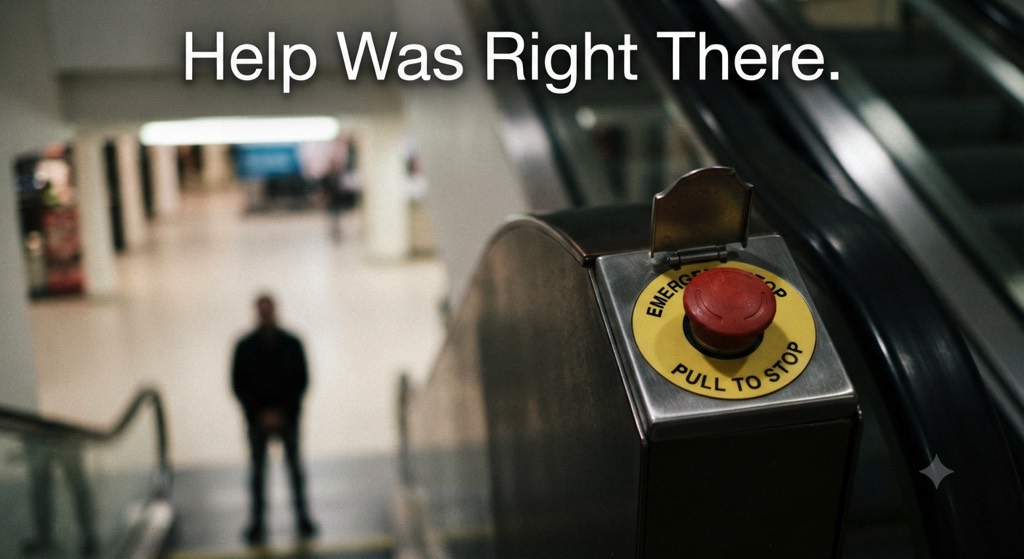
The station had surveillance cameras, and NBC Boston’s investigative team obtained the footage. Less than a minute after Steven fell, someone came down, appeared to briefly try to help, then continued through the fare gates. Over the next several minutes, more than a dozen people passed by. Some stopped and stared. One man pulled on Steven’s legs for a few seconds and gave up. About eighteen minutes passed before anyone called 911, and more than twenty-two minutes before an MBTA employee pressed the emergency stop button — the red button at the top and bottom of every escalator that anyone standing there can push. Steven was taken to the hospital and died ten days later. His mother, shown the video by the news team after the family had been denied it during the investigation, said they treated him like he didn’t exist, and that if someone had taken one minute, he’d still be here.
Here is the tension. The most recent and most convincing research on bystander behavior says the opposite of what that footage seems to show. Richard Philpot and his colleagues, publishing in American Psychologist, coded real surveillance footage of public conflicts on real streets across three countries — the Netherlands, the United Kingdom, and South Africa. In roughly nine out of ten of those conflicts, at least one bystander stepped in to help, and usually several did. The old story that nobody helps, that we all freeze, that a crowd guarantees inaction, turns out to be far too pessimistic. So how can that be true and this also be true?
The honest answer isn’t that the research is wrong or that people are worse than the studies claim. It’s that the study and the case describe two different kinds of situations, and the difference between them is the whole lesson. Philpot’s footage captured public conflicts — fights, arguments, assaults. That kind of event is loud and obvious. There’s a clear aggressor, a clear victim, yelling, shoving. A bystander doesn’t have to work to figure out that something bad is happening. The situation announces itself, and much of the reason the intervention rate ran so high is that the ambiguity had been stripped out. Everyone could see exactly what was going on.
Now picture Steven at the bottom of that escalator at five in the morning: a man lying still, not moving much. From thirty feet away, to someone half-awake on the way to a train, what does that look like? This is where his family’s mention of addiction becomes relevant, and it deserves care, because it’s precisely the psychology at work. A person lying motionless in a subway station early in the morning is, sadly, a sight many commuters have learned to walk past. Their brain files it under he’s sleeping, he’s intoxicated, this isn’t an emergency. Not because they’re cruel, but because the brain does what brains do with an unclear situation: it reaches for the most familiar explanation. And the most familiar explanation, the one that lets you keep walking, was the wrong one.
This is the oldest finding in the bystander literature, and it survives all the new research intact. It goes back to John Darley and Bibb Latané in the years after the Kitty Genovese case. They mapped the steps that have to happen before a person helps, and the first real hurdle, once you’ve noticed something at all, is interpreting it as an emergency. Study after study showed that helping quietly dies right there — not because people are heartless, but because an unclear situation gives everyone permission to assume it’s nothing. Darley and Latané gave part of this a name: pluralistic ignorance. You look around to gauge whether a situation is serious, but everyone else is doing the same thing, keeping a calm face while they check — so the whole crowd reads each other’s calm as proof there’s nothing wrong. Fifteen people pass a man on an escalator, and each one sees fourteen others who didn’t stop, and each concludes it must be fine.
Layered on top of that is diffusion of responsibility: the more people around, the less any one person feels it’s their job to act. Surely someone already called. Surely one of them knows something I don’t. And here’s the cruel irony that ties this back to Philpot’s study. In a loud, obvious street fight, more bystanders means a better chance someone helps, because the situation is clear and all those extra people form a larger pool of potential helpers. But in an ambiguous situation, more bystanders can cut the other way — each additional person who walks past without reacting becomes one more piece of evidence, for the next person, that this is normal. Same crowd size, opposite result. The variable that flips it is whether the situation is clear or ambiguous.
So when Steven’s mother says they treated him like he didn’t exist, it’s easy to see why it looks that way, and no one should argue with a grieving mother about what she saw. But the psychology suggests the footage doesn’t show fifteen heartless people. It shows fifteen people whose brains each made the same ordinary, understandable, catastrophically wrong call. Any one of them, alone, at five in the morning, might well have stopped. It was the combination — ambiguity, the crowd, the early hour, and the assumptions we’ve all absorbed about a still figure in a transit station — that produced twenty-two minutes of nobody pressing a button that was right there.
It’s worth staying skeptical of any tidy explanation, including this one. This reading comes from a news report and edited surveillance video; no one knows what was in the mind of each person who walked past. Maybe someone did call. Maybe someone assumed the man tugging on Steven’s legs had it handled. Reconstructing a psychological story from the outside is exactly the kind of thing to be careful about, because we love neat explanations for other people’s behavior. And this isn’t only a psychology story — there are real questions about the escalator’s safety design and how quickly the MBTA responded, questions the family is right to ask and ones psychology doesn’t answer. The claim here is narrow: it explains the part about the people on the stairs.
The reason the psychology is worth understanding at all comes down to this. If you decide the people who walked past were simply bad people, there’s no lesson in it for you — because you’re not a bad person, so it could never be you. That’s the trap. Fifty years of bystander research keeps landing on the same point: it isn’t about bad people. It’s about ordinary people in a situation structured to produce inaction. Which means it could be any of us. And that’s the hopeful part, because if the cause is the situation and not the character, you can prepare for the situation and inoculate yourself against it in advance.
A few things make a real difference, and they come straight out of the research. Knowing about the bystander effect changes behavior; people who’ve learned about it are more likely to act, because a small alarm goes off — everyone’s walking past, and that’s exactly when I might talk myself out of helping. Resolve the ambiguity out loud: if you see something and you’re unsure, say so, ask are you okay, because the moment someone answers or doesn’t, the situation stops being ambiguous — not just for you, but for everyone else standing there who was privately uncertain. And if you ever need help, or you’re helping and need others to join, get specific. Don’t call out for somebody to phone 911. Point at one person: you, in the gray coat, call 911 right now. The research is consistent here — the instant help is assigned to a specific person, it can’t be diffused to anyone else.
That red button stays with me. It sits at the top and bottom of every one of those escalators, and anyone can push it. It’s the whole thing in miniature: help was physically within reach the entire time. What was missing wasn’t the ability to help but the interpretation — the click in someone’s mind that says this is an emergency and it’s mine to handle. That click is what fifty years of research is really about, and it’s something a person can practice making. Steven McCluskey died in the gap between seeing something and understanding it as an emergency. The most useful thing any of us can do with a story this painful is to let it close that gap a little — to be the one who asks are you okay, who says it out loud, who pushes the button. Not out of heroism, but because we thought about it in advance, on an ordinary day, before ever finding ourselves half-awake at the bottom of a staircase looking at someone who needs us.
Bystander intervention: The act of a witness stepping in to help someone in an emergency. Research increasingly focuses not on whether a lone individual helps, but on the aggregate likelihood that at least one person in a group does.
Bystander effect: The finding, first demonstrated by John Darley and Bibb Latané, that an individual is less likely, or slower, to help when other people are present than when alone.
Interpreting the emergency: The step in Darley and Latané’s model where a person decides whether an ambiguous event actually is an emergency. This is where helping most often fails — an unclear situation invites the assumption that nothing is wrong.
Pluralistic ignorance: A situation in which each person privately feels unsure but reads everyone else’s outward calm as evidence that there’s no emergency — so the group collectively concludes there’s nothing to worry about, even when there is.
Diffusion of responsibility: The tendency for personal responsibility to feel divided among everyone present, so the more bystanders there are, the less any single person feels that helping is their job.
Individual versus aggregate likelihood: A distinction the bystander literature often blurs. The individual likelihood that any one person helps can drop as a crowd grows, even while the aggregate likelihood that at least someone helps rises — because a larger crowd is a larger pool of potential helpers, at least when the situation is clear.
Situational versus dispositional explanation: Whether behavior is explained by the situation a person is in or by the kind of person they are. The bystander research consistently points to the situation — which is why ordinary people, not just callous ones, fail to help.
Sources and References
Darley, J. M., & Latané, B. (1968). Bystander intervention in emergencies: Diffusion of responsibility. Journal of Personality and Social Psychology, 8(4), 377–383. https://doi.org/10.1037/h0025589
Kath, R. (2026). How did a man die after getting caught in an MBTA escalator? NBC10 Boston. https://www.nbcboston.com/investigations/mbta-davis-escalator-death-investigation/3948562/
Latané, B., & Darley, J. M. (1968). Group inhibition of bystander intervention in emergencies. Journal of Personality and Social Psychology, 10(3), 215–221. https://doi.org/10.1037/h0026570
Manning, R., Levine, M., & Collins, A. (2007). The Kitty Genovese murder and the social psychology of helping: The parable of the 38 witnesses. American Psychologist, 62(6), 555–562. https://doi.org/10.1037/0003-066X.62.6.555
Philpot, R., Liebst, L. S., Levine, M., Bernasco, W., & Lindegaard, M. R. (2020). Would I be helped? Cross-national CCTV footage shows that intervention is the norm in public conflicts. American Psychologist, 75(1), 66–75. https://doi.org/10.1037/amp0000469

Leave a Reply