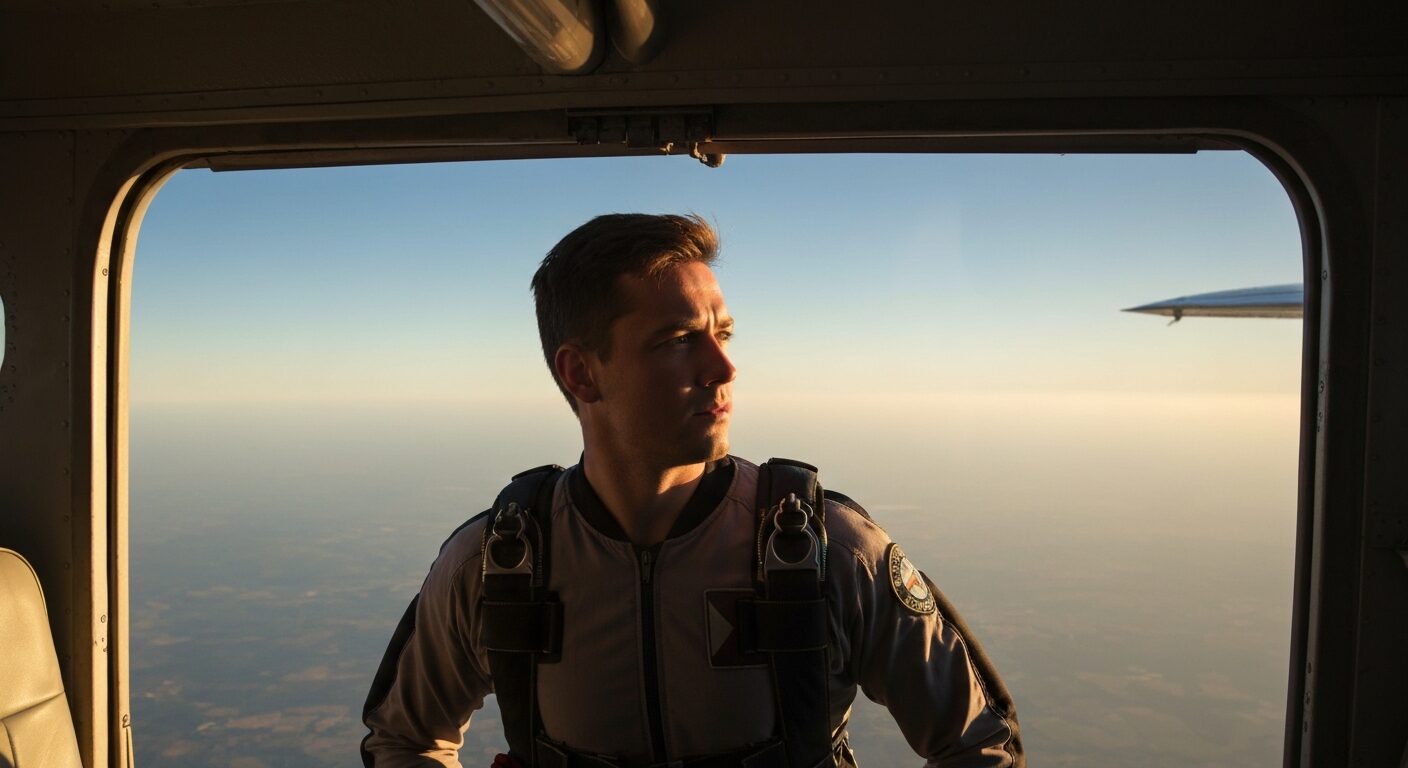
Picture standing in the open door of a plane, wind roaring, the ground a long way down. Almost every part of you is shouting one thing: do not do this. Some people hear that voice, nod, and jump anyway. And here’s the part that really gets me — after a terrible accident, some of them go back up the very next day. Why?
That question came roaring back for me after a recent New York Times feature by Kurt Streeter and Nicholas Bogel-Burroughs, which opened on a single brutal weekend: a skydiving plane crash in Missouri, a fatal BASE jump near Moab, and a rope jump in Brazil where the crew forgot to clip the harness. Strip away the details and the victims all faced the same thing — a brain built to keep them safe, screaming the obvious — and each went anyway.
I’ve actually talked about the people who do this kind of thing before. A while back I interviewed Dr. Kenneth Carter, a psychology professor at the Oxford College of Emory University and the author of the book Buzz: Inside the Minds of Thrill-Seekers, Daredevils, and Adrenaline Junkies. He studies exactly this — and the same New York Times piece quotes him too.
The first thing Carter told me is that “adrenaline junkie” mostly gets it wrong. The trait at the center of this is sensation seeking — the pull toward novel, varied, and intense experiences, and a willingness to take risks to get them. It traces back to Marvin Zuckerman, who discovered it almost by accident while running sensory-deprivation studies. Some people sat for hours in a quiet, blank room and felt fine; others couldn’t last minutes. No test at the time could predict who was who, so Zuckerman built one.
Here’s the piece most people miss: high sensation seekers don’t feel the same panic you and I would. Carter’s work shows they tend to run on a different chemistry — less cortisol, the stress hormone, and more dopamine, the brain’s reward and motivation signal. So the moment that would flood you with dread becomes, for them, a moment of clarity. Time stretches, the noise drops away, and they describe picking out every crack in the rock as they fall past.
Zuckerman’s scale breaks the trait into four parts, and I think this is the most useful way to understand it. The first two tell you what kind of seeker someone is: thrill and adventure seeking (the skydiving, the wingsuits) and experience seeking (fearless eating, far-flung travel, even striking up debates with strangers). The last two tell you how much trouble they might find: disinhibition, the tendency to leap before looking, and boredom susceptibility, how badly they need stimulation. As Carter put it to me, the danger usually isn’t the activity itself — it’s doing it impulsively. “It’s good to look before you leap,” he said, “if you’re leaping off a bridge.”
A couple of things surprised me. Sensation seeking lines up with openness — the Big Five trait about curiosity and appetite for the new — but it is not the same as extraversion. Plenty of high seekers are quiet introverts. And I’ll admit I have skin in this game: I took Carter’s scale and scored a 13, which is low (he scored even lower, an 8). The few points I earned all came from experience seeking — I like exploring strange places. I’m also someone who gets a real jolt of nerves before stepping on stage for community theater, then loves it. Not the same as jumping off a cliff, but maybe a cousin of it.
So what do you do with this? Two things. If you love someone who’s wired this way, understanding the trait helps — it isn’t recklessness for its own sake, and a calmer partner often becomes the “anchor” who keeps the risk in check. And if you’re the seeker, Carter’s warning is the practical gold: the trait isn’t the problem, impulsivity is. Build in the pause. Look before you leap.
If you’re studying psychology, scroll down — I’ve pulled out the key concepts this research illustrates, in plain language you can use for an exam.
Psychology Terms in This Article
Sensation seeking — A personality trait describing how strongly someone is drawn to novel, varied, and intense experiences, and how much risk they’ll accept to have them. Zuckerman’s scale runs from about 8 to 40, with most people near 25; the extreme athletes in Carter’s work often score in the high 30s, which is why the same jump reads as terror to one person and joy to another.
Dopamine — A neurotransmitter tied to reward, motivation, and the anticipation of something good. High sensation seekers appear to get a bigger dopamine payoff (with less of the stress hormone cortisol) from risky, novel situations, which helps explain why danger can feel energizing rather than frightening to them.
Openness — One of the Big Five personality traits, marked by curiosity, imagination, and willingness to try new things. Sensation seeking correlates with openness, which is why the experience-seeking side of the trait shows up in adventurous eaters and travelers, not just cliff jumpers.
Extraversion — The Big Five trait covering sociability and seeking stimulation from other people. The surprising research point is that sensation seeking is not reliably linked to extraversion — many high seekers are introverts — so the two traits should not be confused on an exam.
Trait theory — The approach to personality that explains behavior through stable characteristics that show up across situations and over time. Sensation seeking is a textbook example: it’s measurable, fairly consistent within a person, and even shifts predictably with age, peaking in adolescence and easing as we get older.
Yerkes-Dodson law — The principle that performance improves as arousal rises, but only up to a point, after which it drops — an inverted-U, with the ideal level differing by person and task. It offers a neat way to picture sensation seekers: they may need a much higher level of arousal to hit their personal sweet spot than the rest of us do.
References
- Carter, K. M. (2019). Buzz: Inside the Minds of Thrill-Seekers, Daredevils, and Adrenaline Junkies. Cambridge University Press.
- Streeter, K., & Bogel-Burroughs, N. (2026, June 18). [Feature on extreme-sports deaths and the psychology of risk]. The New York Times.
- Zuckerman, M. (1994). Behavioral Expressions and Biosocial Bases of Sensation Seeking. Cambridge University Press.
- Britt, M. (Host). What’s a High Sensation Seeker? [Interview with Kenneth Carter]. The Psych Files.